


4 minute read
The Rise of Social Instant Games: Why Every Creator Needs One
by Tim CohenThe creator economy has spent the last decade optimizing one thing: content consumption.
Creators learned how to make better videos. Better thumbnails. Better hooks. Better editing. Better algorithms.
But there's a limit to how much attention can be won by asking people to simply watch.
The next phase of the creator economy won't be about creating more content.
It will be about creating experiences.
And one of the biggest opportunities in that shift is something called social instant games.
What Are Social Instant Games?
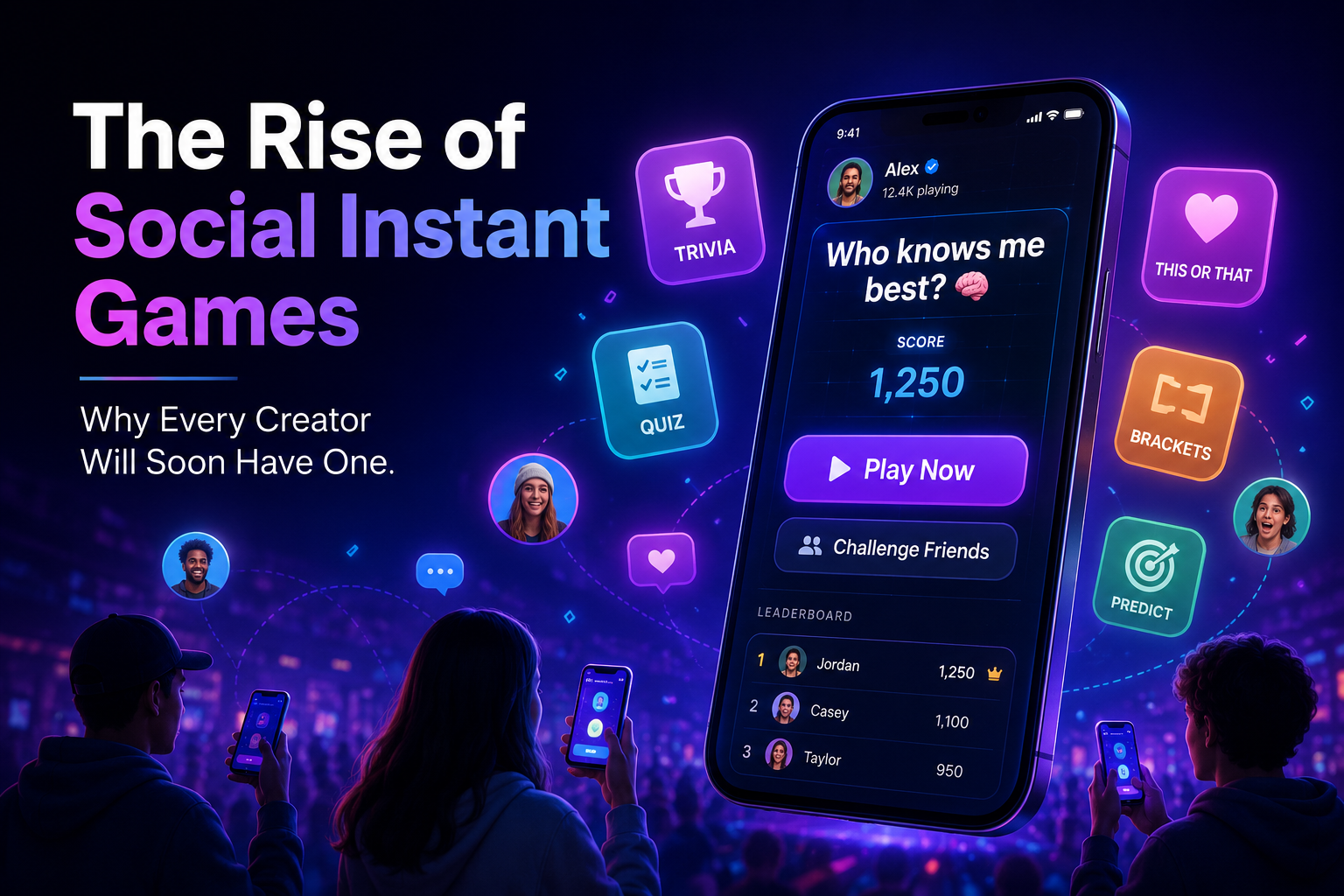
Social instant games are lightweight, web-based interactive experiences that anyone can play immediately—without downloading an app, creating an account, or learning complicated rules.
They're designed to be completed in seconds or minutes rather than hours.
Personality quizzes
Trivia challenges
Prediction games
"Guess my favorite" games
This-or-that choices
Bracket competitions
Memory games
Poll-based competitions
Fan challenges
Interactive stories
Unlike traditional mobile games, their primary purpose isn't entertainment alone.
They're designed to create interaction between a creator and their audience.
We've Optimized Watching. We Haven't Optimized Participation.
Most social media platforms are incredibly good at helping creators broadcast content.
A creator records.
The audience watches.
Then they scroll.
Every platform is competing to improve this experience through recommendation algorithms, AI editing tools, and content discovery.
But very few experiences actually ask the audience to participate.
Participation changes everything.
Instead of spending thirty seconds watching a clip, a fan spends two minutes interacting with it.
Instead of passively consuming, they actively engage.
That creates a stronger connection than another short-form video ever could.
The Shift Toward Owned Audiences
One of the biggest lessons creators have learned is that algorithms change.
Platforms rise.
Platforms decline.
Reach fluctuates.
That's why newsletters, websites, Discord servers, and community platforms have become increasingly valuable.
They give creators a direct relationship with their audience.
Social instant games fit naturally into this shift.
Instead of sending followers to a static webpage, creators can send them to an interactive experience that keeps them engaged while also helping the creator better understand what interests their audience.
Why Web-Based Experiences Matter
The biggest obstacle to most interactive experiences is friction.
Download this app.
Create an account.
Verify your email.
Enable notifications.
Most people leave before they ever begin.
Modern web technologies make that unnecessary for many use cases.
A fan should be able to tap a link in a creator's bio and immediately start playing.
No installation.
No waiting.
No barriers.
Reducing friction dramatically increases the likelihood that someone will actually engage.
Why Games Work
Games naturally encourage behaviors that traditional posts often struggle to achieve.
They create curiosity.
They provide immediate feedback.
They invite replay.
They encourage sharing.
They reward participation.
Even simple interactions can hold attention longer than another static post because people become active participants instead of passive observers.
That's valuable for both creators and their audiences.
This Isn't About Replacing Content
Videos aren't going away.
Neither are podcasts.
Or newsletters.
Or livestreams.
Social instant games aren't replacing those formats.
They're becoming another layer.
A creator might release a YouTube video explaining a topic.
Then link to a quiz that lets fans test what they learned.
A musician might launch an album alongside a lyric challenge.
A fitness coach might publish a weekly workout with an interactive habit tracker.
A sports creator could let fans predict game outcomes before every matchup.
The content starts the conversation.
The interactive experience extends it.
The Next Competitive Advantage
For years, creators competed on production quality.
Then they competed on consistency.
Then they competed on authenticity.
The next advantage may be interaction.
The creators who build memorable experiences—not just memorable videos—will have more opportunities to deepen relationships with their audiences.
In an increasingly crowded creator economy, participation may become one of the strongest differentiators.
Looking Ahead
Every major shift in digital media has expanded how audiences interact with content.
Websites became blogs.
Blogs became social networks.
Social networks became short-form video.
The next evolution may not be another content format.
It may be a participation format.
As web technologies continue to improve and creators seek deeper relationships with their audiences, social instant games have the potential to become a standard part of every creator's toolkit.
The creators who begin experimenting with interactive experiences today may be better positioned for the next chapter of the creator economy than those who continue focusing exclusively on publishing more content.
The future of social media may not be about watching more.
It may be about playing together.